

6 Best Manupatra Alternatives for Legal Research in 2026
If Manupatra subscription costs are eating into your research budget, or you are simply tired of clunky search filters and slow judgment retrieval, you are not alone. Plenty of lawyers, in house teams, and law students search for a manupatra alternative every month, and the good news is that the options in 2026 are genuinely better than what existed even two years ago.
This article gives you a direct answer: six platforms worth trying, ranked by accuracy, coverage of Indian case law, and pricing, including tools that work as a manupatra alternative free of cost for students and solo practitioners on a tight budget. Some rely on the same judgment databases Manupatra draws from, while others use AI to cut research time from hours to minutes.
We cover platforms like SCC Online, Indian Kanoon, and AI native research tools for Indian lawyers including LeXi Agent, comparing them on speed, citation accuracy, and cost. If you handle statutory interpretation, precedent analysis, or case file review as part of your daily practice, this comparison of manupatra alternatives will help you pick the right tool without wasting a free trial period figuring it out yourself.
1. LeXi AI
LeXi AI's platform for Indian legal work is built specifically for legal research, litigation prep, and contract work, rather than being a general research repository with a search bar bolted on. Instead of just returning a list of matching judgments, its research agent explains why a precedent applies to your facts, flags conflicting rulings, and drafts a first pass of your argument or clause. For anyone treating this as a serious manupatra alternative, that shift from search engine to reasoning engine is the whole point.
Key features
Under the hood, LeXi AI bundles four connected tools rather than one search box.
- LeXi Agent: legal research with precedent analysis and instant judgment search across verified databases
- LeXi Desk: contract lifecycle management, including clause risk flagging and translation
- LeXi LiTT: courtroom preparation, case strategy building, and drafting at scale
- LeXi Academy: guided research and drafting practice for law students
On the AIBE 20 evaluation report, LeXi AI scored 98.95 percent, ahead of general models like GPT 5.5 and Claude Opus 4.8 on statutory interpretation and case analysis specific to Indian commercial law.
A legal research tool that only finds judgments is doing half the job; one that explains and drafts around them does the rest.
Who it is for
Solo practitioners juggling drafting and court prep will find the combined workflow saves the most time, since you are not switching between four different logins. Firms and chambers that want one platform for litigation, contracts, and research, instead of separate subscriptions for each, are the clearest fit. Law students preparing for moots or internships also get real value from LeXi Academy's guided practice.
Pricing
LeXi AI offers tiered plans for individual lawyers, chambers, and enterprises, with API access available for teams building custom workflows on top of the platform. Exact pricing depends on team size and module access, so see current LeXi AI plans before you commit to a subscription.
How it compares to Manupatra
Manupatra gives you a large judgment database and editorial commentary, but it stops at retrieval. LeXi AI goes further by summarizing 400-page case files instantly, flagging indemnity and liability risk in contracts, and cutting drafting time by more than 60 percent according to internal benchmarks. If your practice needs both research and drafting speed, LeXi AI covers ground Manupatra was never built to cover.
2. SCC Online
SCC Online has been the default legal database for Indian courts and firms for decades, built around the same Supreme Court Cases reporter that generations of lawyers cite in briefs. It is less an upstart alternative and more the established rival Manupatra has always competed against, with similarly deep coverage of judgments, statutes, and commentary.
Key features
SCC Online's core strength is its citation network. Cross-references between cases are meticulously tagged, and its OnlineDatabase includes journals, digests, and legislative history that many High Court libraries still rely on daily.
- Full text search across Supreme Court and High Court judgments
- SCC citation format, the one most Indian courts expect in filings
- Statute annotations with amendment history
- Mobile app for on the go case checks
Who it is for
Litigators who already cite SCC format in their pleadings get the smoothest transition, since the platform matches courtroom conventions exactly. Larger firms with established SCC subscriptions from years past often stick with it out of habit rather than re-evaluating newer tools.
Familiarity with a citation format is not the same as research speed, and SCC Online trades on the former.
Pricing
Subscription tiers vary by firm size and module access, generally priced close to Manupatra, with individual and institutional plans available on request.
How it compares to Manupatra
Both platforms overlap heavily on judgment coverage and neither offers AI-driven case strategy or drafting, leaving research and drafting as separate steps either way.
3. Casemine
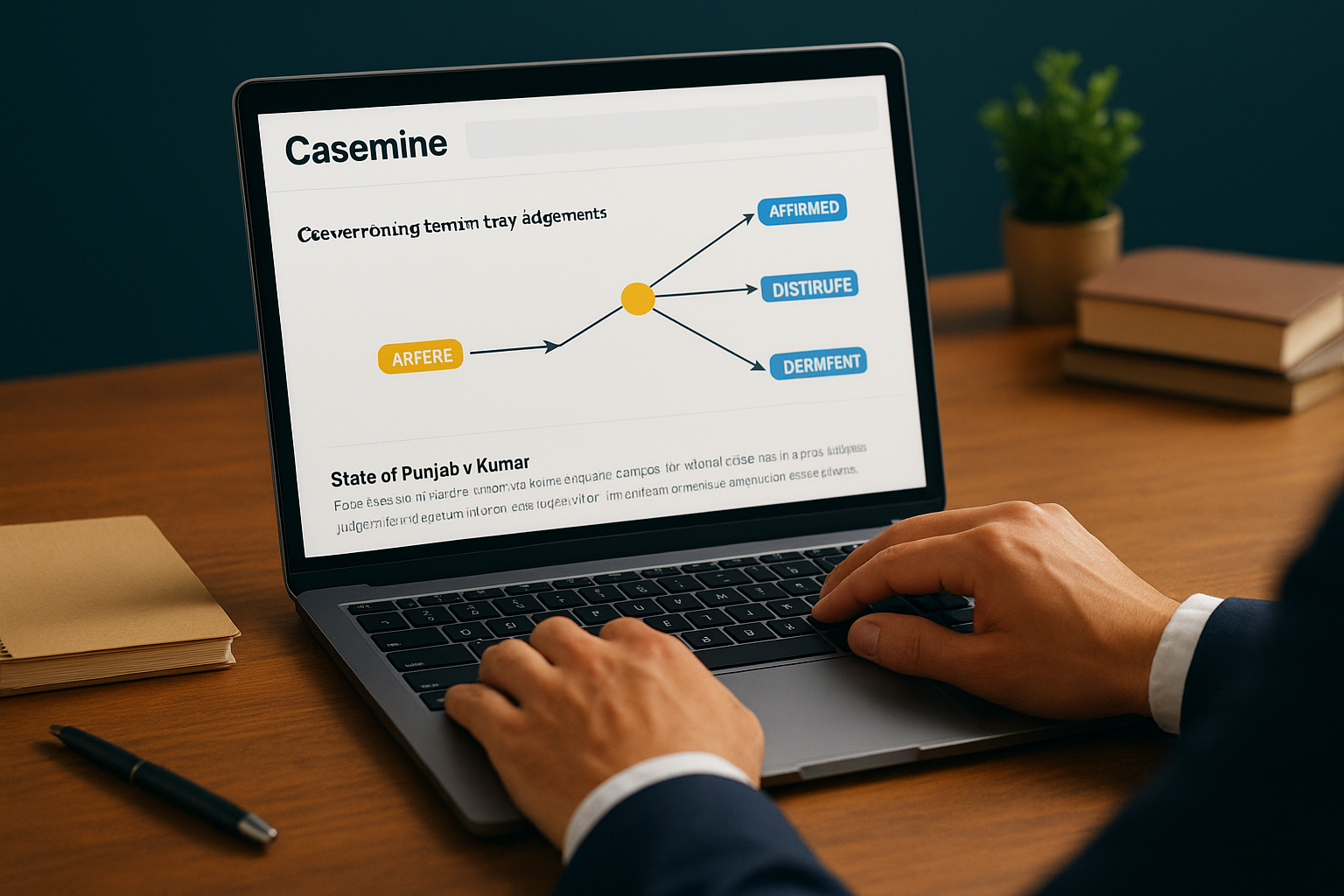
Casemine takes a different approach from SCC Online and Manupatra by leaning on its TrueCite technology, a citation analysis engine that maps how later judgments treat a precedent, whether they affirm, distinguish, or overrule it. That visual citation graph is genuinely useful when you need to know fast whether a case you are about to rely on has been quietly weakened by later benches.
Key features
Casemine's search works across Indian, US, and UK case law, which helps if your practice touches cross-border disputes or comparative arguments.
- TrueCite citation graphs showing how later cases treat a precedent
- Coverage spanning Indian, US, and UK judgments
- Judgment summaries generated automatically for faster skimming
- Boolean and natural language search options
Knowing a precedent still holds after later rulings matters as much as finding the precedent itself.
Who it is for
Litigators who need to verify precedent strength before filing, particularly in appellate matters, get the most out of Casemine's citation mapping. Researchers working on comparative or cross-border questions also benefit from its non-Indian coverage, something Manupatra does not offer.
Pricing
Casemine offers a free tier with limited searches per month, alongside paid plans for individuals and firms that unlock full citation graphs and unlimited access. This makes it a reasonable entry point if you are testing a manupatra alternative free of upfront cost before committing to a paid subscription elsewhere.
How it compares to Manupatra
Manupatra wins on sheer volume of Indian statutory material and commentary, but Casemine's citation graphing gives sharper precedent validation than Manupatra's flatter search results.
4. LegitQuest
LegitQuest built its name on AI powered headnotes, short machine generated summaries attached to every judgment so you can judge relevance before opening the full text. Bombay High Court and Delhi High Court practitioners often mention it as the platform they reach for when Manupatra's search returns too many loosely related results.
Key features
Quick Search is the standout tool here, letting you paste a paragraph of facts and get matching precedents ranked by relevance rather than keyword overlap alone.
- AI generated headnotes on most reported judgments
- Quick Search for fact based precedent matching
- Citation index tracking how later benches treat a ruling
- Coverage of tribunals alongside High Courts and the Supreme Court
A headnote that saves you two minutes per judgment adds up fast across a hundred searches a week.
Who it is for
Associates handling high volume research requests benefit most, since Quick Search cuts down the judgments you need to actually read in full. Chambers that argue frequently before tribunals also value LegitQuest's coverage there, an area where Manupatra is comparatively thin.
Pricing
LegitQuest runs on subscription tiers priced for individuals, chambers, and firms, with a limited free trial available before you commit. It sits close to Manupatra on cost, without a meaningfully cheaper entry point.
How it compares to Manupatra
Manupatra still edges out LegitQuest on statutory commentary and bare volume of archived material. LegitQuest pulls ahead on tribunal coverage and the speed its headnotes add to daily research, making it a solid manupatra alternative for volume litigation practices.
5. Free alternatives: IndianKanoon, e-SCR and vLex Open
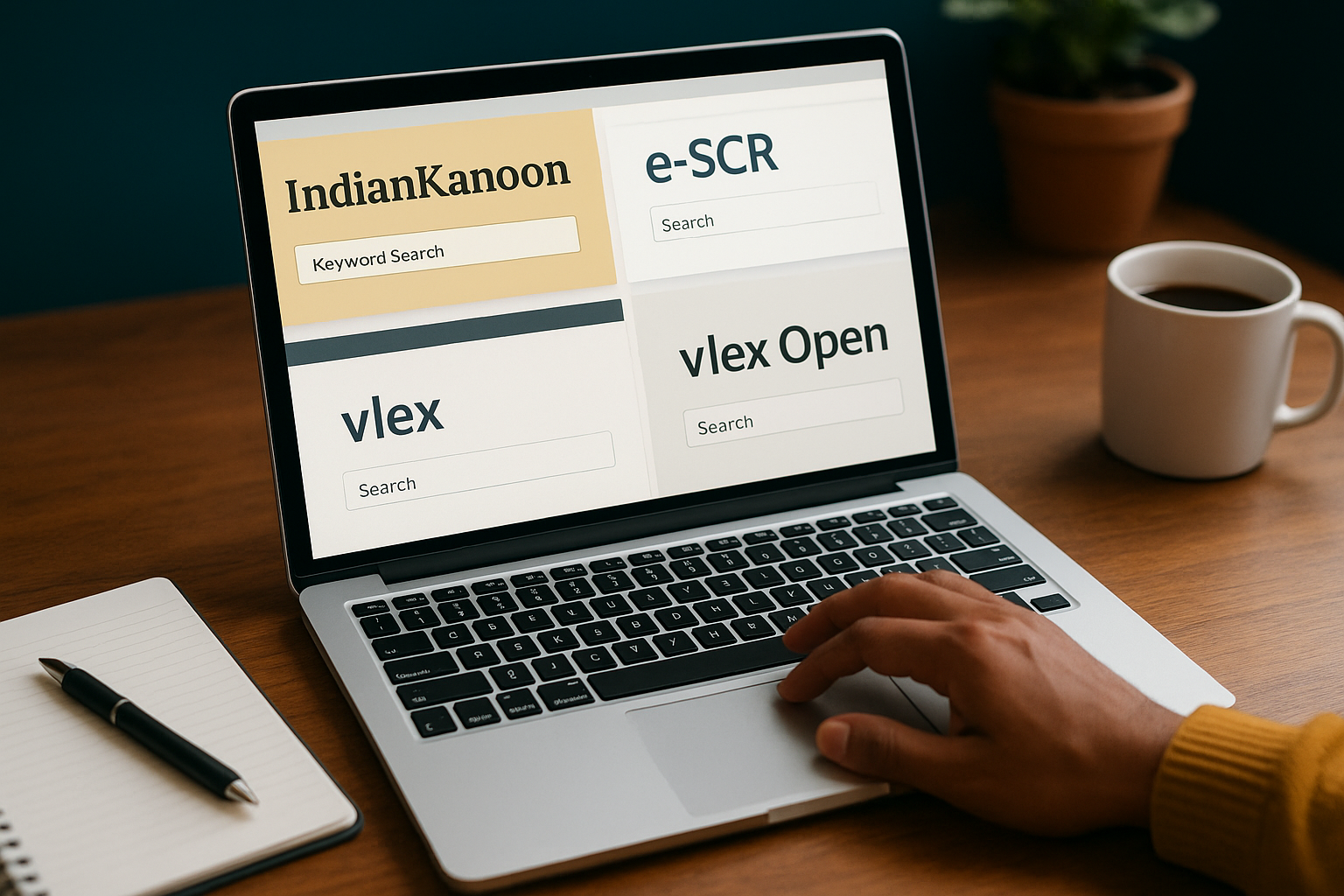
When budget is the real constraint, three free platforms cover most of what a solo practitioner or student needs. Indian Kanoon, the Supreme Court's own e-SCR portal, and vLex Open together give you searchable judgments without a subscription, making them the closest thing to a manupatra alternative free of cost that still holds up for daily use.
Key features
Each platform covers different ground, so pairing them often works better than picking just one.
| Platform | Best for | Cost |
|---|---|---|
| Indian Kanoon | Fast keyword search across decades of judgments | Free |
| e-SCR | Certified Supreme Court judgments straight from source | Free |
| vLex Open | Statutes and case law with basic citation links | Free tier |
Free research tools will not replace a paid subscription entirely, but they will cover eighty percent of routine lookups.
Who it is for
Students building moot court research and solo lawyers with thin research budgets get the most mileage here. Practitioners who mainly need quick statute checks or a single judgment citation rarely need to pay for anything more.
Pricing
All three are free, though e-SCR limits itself to Supreme Court judgments and vLex Open caps deeper features behind a paid upgrade.
How it compares to Manupatra
Manupatra still wins on editorial commentary, cross-referencing, and statutory annotations that these free tools simply do not offer. But for bare judgment retrieval, Indian Kanoon in particular searches nearly as fast, without the subscription fee attached.
Picking the right fit for your practice
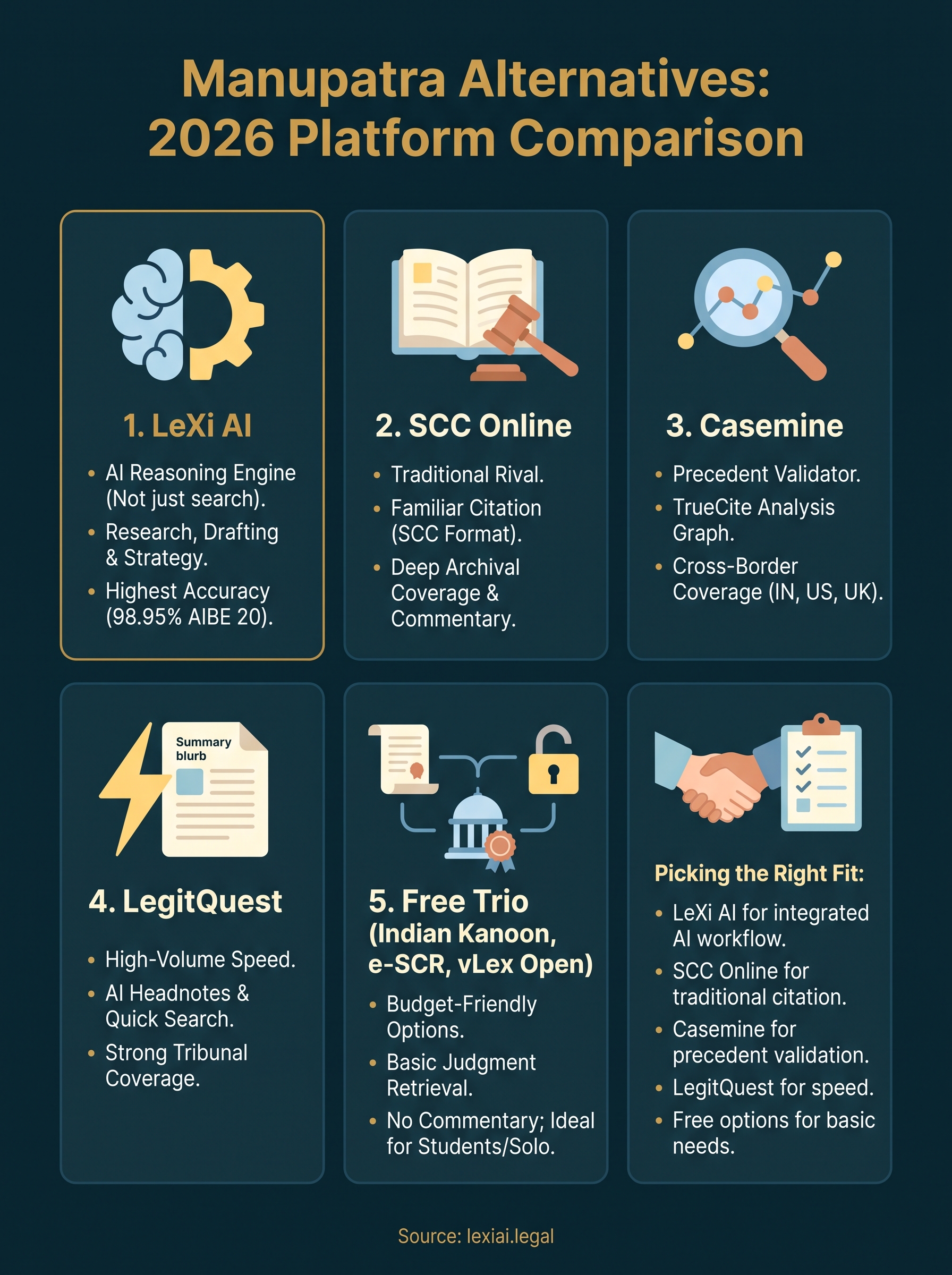
No single tool wins every category. SCC Online and LegitQuest suit lawyers who want familiar citation formats and tribunal coverage, Casemine helps when precedent strength needs verifying fast, and the free trio of Indian Kanoon, e-SCR, and vLex Open covers students and thin budgets well enough for daily use.
But if you want research, drafting, and case prep in one place instead of stitching together three logins, LeXi AI is built for that. Its 98.95 percent score on the AIBE 20 benchmark reflects real accuracy gains on Indian statutory interpretation, not just marketing copy.
Manupatra remains solid for archival depth, but it was never built for AI-assisted drafting or case strategy. If your practice needs both, stop paying for retrieval alone and see what a reasoning engine adds. You can test LeXi AI free for a few matters before deciding whether it earns a permanent spot in your workflow.